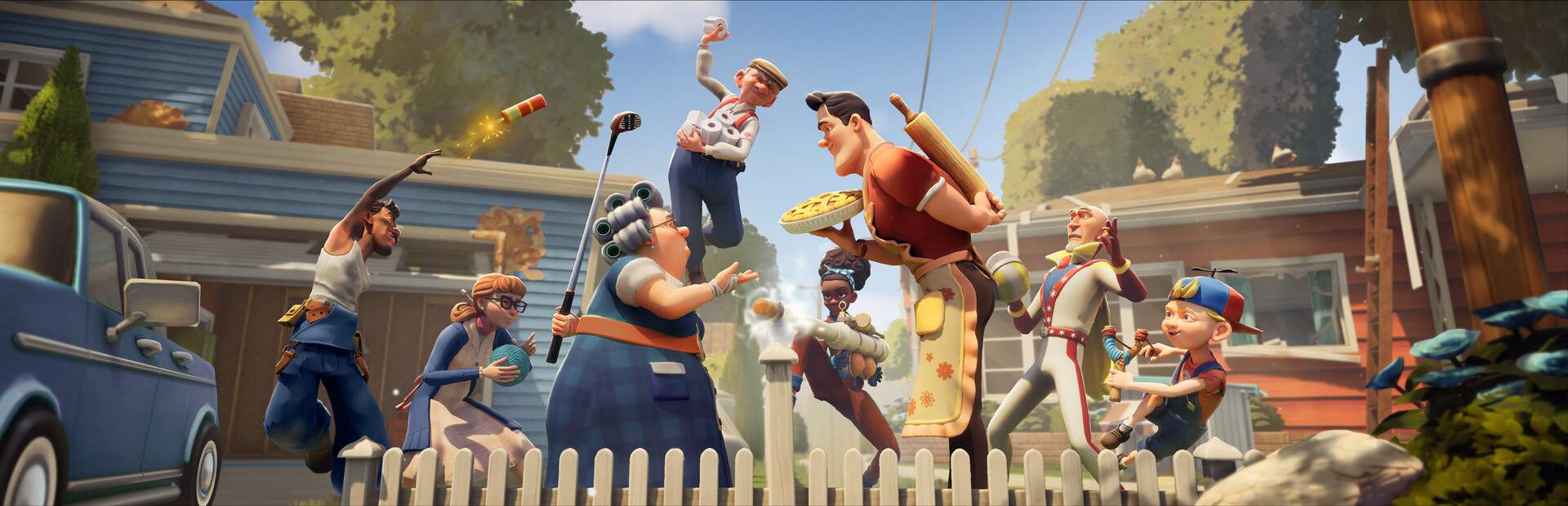
- Neighbors Suburban Warfare is a 4v4 online multiplayer game of attacking and defending suburban houses
- Slapstick chaos is the core appeal: traps, bottle rockets, rakes, and lawn-chair rocket ambushes
- Strengths: smooth controls, deep trap-and-environment strategy, bright cartoon visuals
- Weaknesses: character balance issues, thin tutorial, limited launch content, matchmaking bugs
- Verdict: great with friends, approach with caution solo
Neighbors Suburban Warfare Review: First Impressions
Neighbors Suburban Warfare drops two teams of four into a peaceful suburban street and turns it into a slapstick battlefield. One side defends a house, the other attacks, and everything from garden gnomes to garage doors becomes a weapon. It is loud, ridiculous, and unlike most multiplayer shooters on the market right now.
Video Highlights:
- 4v4 attack-and-defense structure with trap-heavy gameplay
- Character roles split between defenders and infiltrators
- Balance problems with overpowered abilities and spammable traps
- Limited launch maps and characters, more content teased
The core loop is simple but effective: hold your front porch like a fortress, then flip roles and ambush the enemy with someone flying in on a lawn chair strapped with fireworks. Matches reward creativity and teamwork over raw aim.
If you're tired of gritty military shooters and want something fast, funny, and physics-driven, this is a genuine breath of fresh air. Solo grinders should temper expectations.
Gameplay and Core Mechanics
The gameplay is smooth and fast-paced. Characters are easy to control, but the mechanics run deeper than run-and-gun combat. Success depends on trap placement, environmental positioning, and coordinated attacks.
Each character has a unique special ability and a defined team role:
| Role | Playstyle | Strengths |
|---|---|---|
| Defender | Heavy gadgets and traps | Holds choke points, fortified positions |
| Infiltrator | Fast and sneaky | Slips past defenses, flanks enemies |
| Support | Utility tools | Enables teammates, disrupts enemies |
| Bruiser | Melee brawling | Swings rakes and bats up close |
The environment itself is a weapon. You can hide in bushes, climb onto sheds, kick open gates for surprise attacks, and use rooftops, garages, and swimming pools to outmaneuver opponents.
Every match feels different depending on your team's lineup. The mix of character types encourages experimentation, which keeps the formula fresh far longer than the raw content count suggests.
Game Modes, Maps, and Presentation
Beyond the main attack-and-defense mode, the game ships with several alternate modes:
| Mode | Focus | Vibe |
|---|---|---|
| Attack & Defend | Core 4v4 objective | Strategic chaos |
| Total Destruction | Wreck everything | Pure mayhem |
| Backyard Brawl | Close-quarters fighting | Fast and scrappy |
| Steal the Gnome | Objective stealing | Heist-style comedy |
Visually, the game leans into a bright, cartoonish style that fits the over-the-top action perfectly. Suburbs look like they were pulled from an animated show, except the streets are full of booby traps and explosions. Maps are built around familiar neighborhood landmarks — garages, rooftops, pools — with reactive details everywhere.
The sound design amplifies the comedy: exaggerated explosions, heavy trap clunks, and characters yelling cheesy one-liners mid-swing. The upbeat music keeps the tone playful even in tense matches.
Visuals
- Bright cartoon style
- Animated-show aesthetic
- Detailed, reactive maps
Audio
- Exaggerated effects
- Characterful voice lines
- Upbeat, playful music
Map Design
- Neighborhood landmarks
- Bushes, sheds, rooftops
- Ambush points everywhere
This game never takes itself seriously, and that's the point. If you want dark and gritty, look elsewhere — Neighbors Suburban Warfare is goofy and proud of it.
Problems: Balance, Content, and Bugs
No review is complete without the rough edges, and there are several worth flagging before you buy.
| Issue | Severity | Details |
|---|---|---|
| Character balance | High | Some abilities feel overpowered with no counter |
| Trap spam | Medium | Certain gadgets are too easy to spam |
| New-player onboarding | Medium | Thin tutorial, steep early learning curve |
| Launch content | Medium | Few maps and characters, repetition sets in |
| Technical issues | Medium | Matchmaking hiccups, crashes, server lag spikes |
New players get hit with abilities, traps, tools, and objectives all at once with little tutorial support. Without a communicating team, your first few matches can feel like total confusion. It gets easier — but the early curve is real.
The developers have teased new content and are working on updates, so the content drought may be temporary. Still, if you grind multiplayer games for weeks at a stretch, expect to burn through the current offerings quickly.
How to Get Started: Beginner Path
If you decide to jump in despite the rough edges, follow this sequence to shorten the learning curve:
Learn One Role First
Pick a single character and master their ability before rotating. Defenders are the most forgiving starting point because trap play teaches map knowledge.
Study the Maps
Walk each map in casual matches. Note bushes, shed rooftops, gates, and side routes — every corner hides an ambush opportunity.
Coordinate With Your Team
Use voice chat. A mediocre team that communicates consistently beats a silent squad of skilled players in this game.
Experiment With Combos
Once comfortable, test trap-and-gadget combinations. Creative setups — like fireworks-strapped lawn chairs — win matches that raw aim cannot.
Rotate Modes
Switch between Total Destruction, Backyard Brawl, and Steal the Gnome to keep skills sharp and delay content burnout.
Your First Week Checklist:
- Master one defender and one infiltrator
- Memorize ambush spots on every launch map
- Play at least one match in every game mode
- Build one custom trap combo that works
- Squad up with friends for coordinated matches
Neighbors Suburban Warfare is at its best with a full squad of friends. The chaos scales with coordination, and laughing at ridiculous defeats softens the balance frustrations.
Final Verdict and FAQ
So, is Neighbors Suburban Warfare worth playing? If you want something fast, funny, and different from serious military shooters — yes, with caveats. In a good match with a solid team, it's one of the most entertaining multiplayer experiences available right now. But imperfect balance, launch-window bugs, and limited content mean solo players should wait for a few patches or a sale.
| Category | Score |
|---|---|
| Gameplay fun | ★★★★☆ |
| Visuals and audio | ★★★★☆ |
| Balance | ★★★☆☆ |
| Content at launch | ★★★☆☆ |
| Technical polish | ★★★☆☆ |
| Overall | ★★★☆☆ (leaning up) |
A goofy, explosive, creative multiplayer game that offers something genuinely different. Come for the chaos, bring friends, and be ready for a few bumps along the way.
Q: Is Neighbors Suburban Warfare worth playing?
Yes, if you enjoy fast, comedic multiplayer and can squad up with friends. The balance and content limitations are real, but the core chaos is highly entertaining. Solo players may want to wait for patches.
Q: What game modes are in Neighbors Suburban Warfare?
The core 4v4 attack-and-defense mode plus Total Destruction, Backyard Brawl, and Steal the Gnome, which add variety to the trap-and-ambush formula.
Q: Is the game beginner-friendly?
Not especially. The tutorial is thin and the game throws abilities, traps, tools, and objectives at you at once. It gets easier over time, but expect a confusing first few matches.
Q: Does Neighbors Suburban Warfare have balance problems?
Yes. Some characters feel overpowered, certain traps are easy to spam, and matchmaking can be unstable with occasional crashes and server lag spikes. Updates are in development.