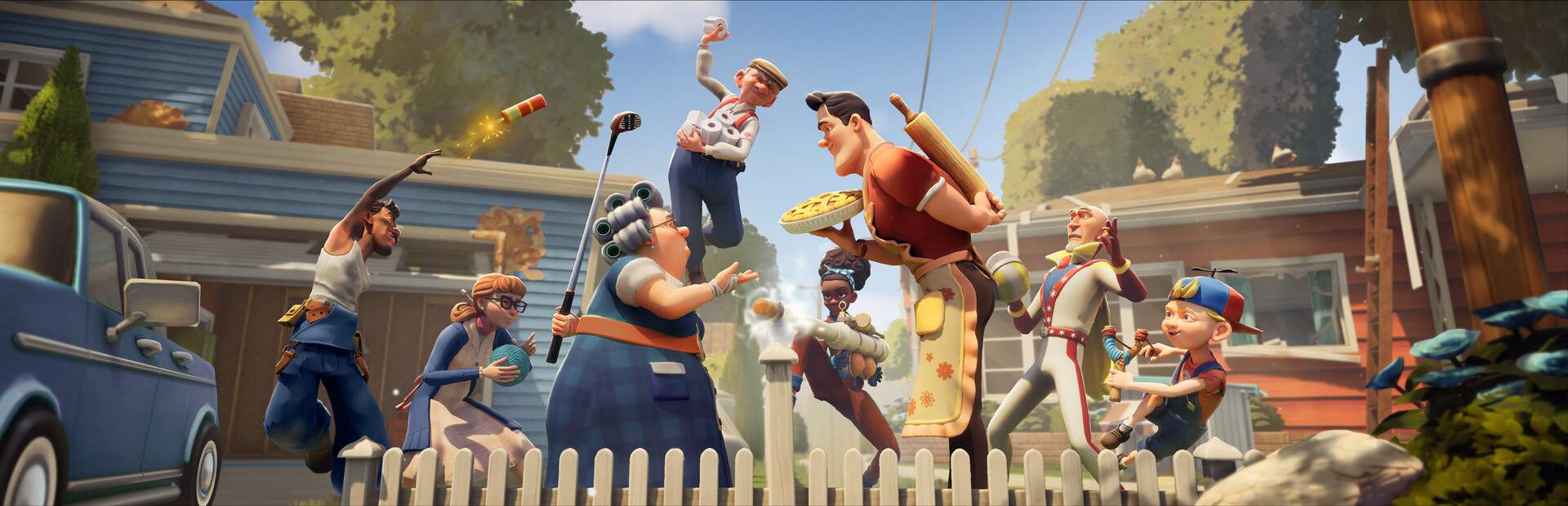
- Neighbors Suburban Warfare is worth playing if you want fast, funny 4v4 multiplayer chaos with friends.
- Core loop: defend or attack houses using traps, gadgets, and ridiculous neighborhood tools.
- Main drawbacks: character imbalance, a steep learning curve, limited launch content, and occasional bugs.
- Best experience: squad up with communicative friends rather than going solo with randoms.
- Verdict: a breath of fresh air for casual players; competitive grinders may burn out quickly.
What Is Neighbors Suburban Warfare?
Neighbors Suburban Warfare is a 4v4 online multiplayer game where teams either defend or attack houses in a deceptively peaceful suburban setting. Beneath the quiet streets, you'll set garden traps, launch bottle rockets over fences, swing rakes like swords, and ambush enemies riding lawn chairs strapped with fireworks. It's teamwork, strategy, and slapstick madness rolled into one package.
Video Highlights:
- 4v4 attack-and-defend gameplay with trap-heavy strategy
- Multiple modes including Total Destruction, Backyard Brawl, and Steal the Gnome
- Cartoonish visuals and reactive suburban environments
- Balance issues and a thin tutorial hold it back at launch
The core structure rewards planning as much as reflexes. You're not just running around shooting — success depends on trap placement, environmental awareness, and coordinating with your squad.
Don't judge the game by your first match. The systems click after a few rounds once you understand how abilities, traps, and objectives interact.
Gameplay Strengths and Weaknesses
The gameplay is smooth, fast-paced, and surprisingly deep. Each character has a unique ability and team role — some excel at defense with heavy gadgets, while others are fast infiltrators. Maps built around garages, rooftops, and swimming pools reward creativity: hide in a bush, climb a shed, or kick open a gate to surprise attackers.
| Aspect | Rating | Notes |
|---|---|---|
| Combat feel | ★★★★☆ | Smooth, responsive, easy controls |
| Strategic depth | ★★★★☆ | Traps and environment use reward planning |
| Character variety | ★★★☆☆ | Distinct roles, but limited roster at launch |
| Balance | ★★☆☆☆ | Some abilities overpowered, trap spam common |
| Sound design | ★★★★★ | Exaggerated, personality-filled voice lines |
| New-player onboarding | ★★☆☆☆ | Minimal tutorial, steep early learning curve |
Some characters feel significantly stronger than others, and certain traps are easy to spam. Expect occasional matches where one overpowered ability overwhelms your team with no clear counter.
Game Modes Compared
House Attack/Defense
- Core 4v4 mode
- Fortify or besiege homes
- Trap-focused strategy
Total Destruction
- Maximum chaos
- Environment-wrecking objective
- Great for casual fun
Steal the Gnome
- Objective stealing
- Rewards speed and sneaking
- Fast infiltrator characters shine
Each mode shifts which characters and tactics perform best, so experimenting with your team lineup keeps matches feeling fresh.
| Mode | Best For | Key Skill |
|---|---|---|
| Attack/Defense | Strategic players | Trap placement, coordination |
| Total Destruction | Chaos lovers | Aggression, gadget use |
| Backyard Brawl | Brawling fans | Close combat, timing |
| Steal the Gnome | Speedrunners | Mobility, map knowledge |
The launch map and character pool is well-designed but limited. Repetition can set in quickly if you grind multiplayer games for weeks, though new content has been teased.
Getting Started: Steps for New Players
The game throws a lot at you at once — abilities, traps, tools, and objectives. Follow this path to shorten the learning curve:
Learn Your Character's Role
Pick one defender and one fast infiltrator. Understand their special ability before branching out to the rest of the roster.
Study the Maps
Walk each map in casual matches. Note bushes for hiding, sheds for climbing, and choke points where traps hit hardest.
Master Trap Placement
Place traps at gates, porches, and flanking routes rather than open yards. Good placement beats raw spam every time.
Communicate With Your Squad
Call out enemy positions and coordinate pushes. A communicating team consistently beats four skilled solo players.
Rotate Modes
Switch between modes to learn different skills — Steal the Gnome teaches mobility, while Defense teaches fortification.
Squad up with friends using voice chat from your very first match. Communication largely offsets the confusing early-game experience.
Technical Issues and Content Outlook
| Issue | Severity | Impact |
|---|---|---|
| Matchmaking hiccups | Moderate | Occasional slow or lopsided matches |
| Crashes mid-game | Moderate | Some players report in-match crashes |
| Server lag spikes | Minor | Intermittent, not game-breaking |
| Limited maps/characters | Moderate | Content dries up for heavy grinders |
None of these problems are game-breaking, and they're common for smaller multiplayer launches. The developers have teased updates and new content, but as it stands, the package isn't quite complete.
If you plan to jump in on day one, expect some bumps. Waiting for patches is a reasonable option if you're sensitive to bugs and balance problems.
Before You Buy, Check These:
- Do you have friends to squad up with?
- Are you okay with a limited map and character roster?
- Can you tolerate early balance and bug issues?
- Do you enjoy goofy, lighthearted multiplayer over serious shooters?
Final Verdict and FAQ
So, is Neighbors Suburban Warfare worth playing? If you want something fast, funny, and different from the usual serious military shooters, it's a breath of fresh air. With a solid, communicating team, it delivers some of the most entertaining multiplayer matches around — you'll laugh, rage, and try launching a toaster across a yard just to see what happens. Approach with mild caution: it's imperfect, but refreshingly different.
Q: Is Neighbors Suburban Warfare worth playing solo?
It's playable solo, but the experience improves dramatically with friends. The game throws many systems at new players with little tutorial, and teams that communicate well consistently outperform groups of solo players.
Q: What game modes are available?
Beyond the core 4v4 attack-and-defend mode, the game includes Total Destruction, Backyard Brawl, and Steal the Gnome, each emphasizing different skills like aggression, close combat, or infiltration.
Q: Is the game balanced at launch?
Not fully. Some characters feel overpowered, and certain traps and gadgets are easy to spam, which can disrupt match flow. The developers are expected to address this in future patches.
Q: Are there game-breaking bugs?
No. Reported issues include occasional crashes, matchmaking hiccups, and server lag spikes — annoying but not game-breaking, and typical of smaller multiplayer releases at launch.